
Cooper Street and adjacent blocks in Camden, New Jersey, are a setting for learning about how cities grow and change--and for discovering how individual decision-making affects the vitality and sustainability of urban neighborhoods.
Research into the social history of Cooper Street and its vicinity is creating new knowledge about Camden, New Jersey, residents during the city’s period of greatest growth and later transitions. Rutgers-Camden students contributing to this project gain research and writing skills and insight into urban history, historic preservation, and historical interpretation. As we learn, we strive to call attention to Cooper Street as an asset for the campus and surrounding communities.
During 2021, this project expanded to include adjacent blocks of the Rutgers-Camden campus. Our research documents the neighborhood that existed prior to urban renewal in the 1960s to create the campus.
Click map to explore house histories.
Recently Added
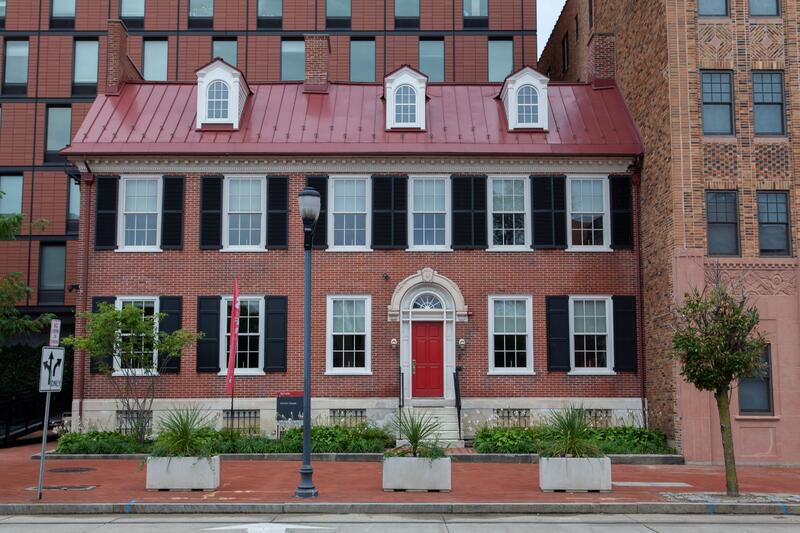
2019 photograph by Jacob Lechner.
312 Cooper Street (the Alumni House)
This house, built c. 1802, is the oldest surviving building on Cooper Street. Later numbered 312 Cooper Street, the house originally served as a countryside summer retreat for a Philadelphia merchant, Edward Smith, his family, and their domestic servants. Later uses illustrate the changing nature of Cooper Street, as the former family home became an organization headquarters for the Camden Republican Club and the Camden County Chapter of the American Red Cross, among others. Currently the Alumni House for Rutgers-Camden, its restoration earned a Grand Jury Award from the Preservation Alliance for Greater Philadelphia.

406 Penn Street, right (early twentieth century postcard, Camden County Historical Society).
406 Penn Street (the Admissions Office)
Built in 1869, this distinctive home is a survivor from the neighborhood that developed in the area of the Rutgers-Camden campus in the decades after the Civil War. It was the longtime home of advertising innovator F.W. Ayer and his family. It became the birthplace of the Rutgers-Camden campus in 1946, when it was purchased for two predecessor institutions, the South Jersey Law School and College of South Jersey.