Significance
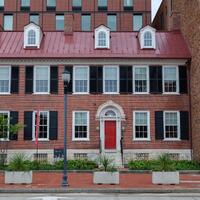
This house, built c. 1802, is the oldest surviving building on Cooper Street. Later numbered 312 Cooper Street, the house originally served as a countryside summer retreat for a Philadelphia merchant, Edward Smith, his family, and their domestic servants. Later uses illustrate the changing nature of Cooper Street, as the former family home became an organization headquarters for the Camden Republican Club and the Camden County Chapter of the American Red Cross, among others. Currently the Alumni House for Rutgers-Camden, its restoration earned a Grand Jury Award from the Preservation Alliance for Greater Philadelphia.
History
Camden was little more than three clusters of buildings near the ferry landings on the Delaware River in 1801, when Philadelphia iron merchant Edward Smith began to buy property to build his “mansion house or summer residence.” For more than fifty years, this house—which originally faced in the opposite direction, toward Market Street—served as a summertime retreat for Smith, his wife Sarah, eventually seven children, and live-in domestic servants. The lots purchased in 1801 spanned 40 feet, the original width of the house, and extended from Cooper to Market Street. Over time, Smith acquired most of the western half of the block.
Edward and Sarah Smith both came from families with deep roots in South Jersey and substantial wealth. Edward, whose Quaker great-grandfather had been among the first English settlers of Salem County, inherited a share of the family’s extensive landholdings. Sarah’s family, the Maskells, were prominent Presbyterians in Cumberland County who owned farms and invested in stocks, bonds, and mortgages. After they married, in the late 1790s Edward and Sarah moved to Philadelphia (then the capital of the United States). By the time they built this summer home, in 1801-1802, they were in their early 30s with three small children and a fourth on the way. In 1811, they gained a close neighbor when Sarah’s sister, Hannah Maskell, moved from Cumberland County and built a similar brick house next door (the house is no longer standing).
In Philadelphia, the Smiths lived and operated their business near the Delaware River waterfront, and they joined the Second Presbyterian Church. Edward Smith and his eldest son Thomas, who joined him in the business, dealt in iron goods such as stoves, nails, hoops for wagon wheels, and iron bars—materials in high demand in growing, industrializing cities like Philadelphia. Their trade included imports from Russia, Sweden, and England, and they acquired at least two schooners to carry goods to New York. In 1819, Smith significantly expanded his investments in the iron industry by purchasing the Cumberland Furnace, a blast furnace and forge near Millville, New Jersey. Along with the buildings and equipment necessary to produce bog iron, wrought iron, and charcoal fuel for the furnace, the property spanned across 17,000 acres of pinelands in Cumberland and Atlantic Counties. By the 1830s, the Smiths moved their Philadelphia business into a newly built warehouse on Front Street, and as the United States entered the railroad age, they supplied iron for engines and boilers made by the Baldwin Locomotive company.
A new era for the Smith’s summer home in Camden opened in 1857, when Edward Smith died and left this property and others to his eldest daughter. Esther Maskell Smith Newkirk, who had married prominent Philadelphia businessman Matthew Newkirk, has been credited with enlarging the house and changing its primary entrance to face Cooper Street. Although the Newkirks primarily lived in Philadelphia, they also spent time in Camden and contributed to founding important community institutions. For example, at this address in 1865 they hosted the organizational meeting for the Camden Home for Friendless Children and its first annual meeting a year later. The children’s home, which was formed to serve Civil War orphans, continued to shelter local youth for more than a century. Esther Newkirk was also among the founding members of Camden’s First Presbyterian Church.
Rental Property
By the late 1860s, the Newkirks began to rent out the house, at first to a family with similar economic connections to the Philadelphia waterfront. Thomas McKean Lee had retired from his maritime equipment business on the Delaware River wharves by the time he moved into the former Smith summer home with his family in 1868. The Lees, residents of Camden for more than 20 years, had gained local renown when four of their five adult sons enlisted to fight in the Civil War. For about four years, their household here consisted of Thomas Lee and his wife, Eliza, and two of their adult sons: John, who had taken over the business, and Thomas Jr., who had been severely wounded in the battles of Chancellorsville and Spotsylvania. They also had a much younger son still in school. At the time of the 1870 Census, the occupants of the house also included a business partner, the partner’s wife, and their two young children. To maintain the large home, the Lees employed three domestic servants: John Olmstead (or Armstead), a Black man born in Virginia; and Catharine and Ellen O’Neil, who were both Irish immigrants.
As a rental, the house also brought a notable Mexican-American family to Camden for a brief time. Mexican-born Marianita Cosio Mallet-Prevost and her husband, Philadelphia-born Dr. Grayson Mallet-Prevost, leased the home for about three years (1878-80). Dr. Mallet-Prevost came from a family of French descent, but he had traveled to Mexico as a U.S. Army surgeon during the Mexican-American War. There, he met and married Marianita, the only daughter of a prominent local citizen (her father, Don Severo Cosio, later served as governor of the State of Zacatecas). By the time the Mallet-Prevost family came to Camden, their household included eight children ranging in age from 1 to 23, all but one born in Mexico. (One of the sons, Severo, became a lawyer who represented the U.S. government in international boundary negotiations and in 1912 helped to found the Pan American Society of the United States.) The Mallet-Prevost family employed one Irish immigrant servant, Catharine Gallin.
Schools for Girls
Twice, the building served as a private boarding school for girls. The Camden Boarding School for Young Ladies (1872-74) offered the “English branches” including grammar, reading, history and geography, and arithmetic, as well as options for studying foreign languages, art, and music. The school may have been an important source of income for the family of a retired Disciples of Christ minister, Rev. Reuben Lindsay Coleman. For reasons unknown, the Colemans relocated to Camden from Virginia, and by 1872 they acquired a girls’ school that had been operating at 315 Cooper Street. They then leased the former Smith summer home across the street to serve as their residence as well as the boarding school. While Rev. Coleman occasionally preached in local churches, Elizabeth Coleman, more than 20 years younger than her husband, served as principal of the school with two of her adult daughters as teachers. They advertised vigorously, emphasizing their commitment to “moral and intellectual improvement of the pupils” and the school’s “large and well ventilated” rooms and “ample and beautiful grounds.” At the conclusion of the 1873 school year, the students offered a public program of music and elocution, but the school apparently closed by 1874.
Another school operated at this address during the 1880s, led by a granddaughter of the home’s original owner. Sarah Westcott, who grew up in Salem, would have been familiar with the Cooper Street home from summertime visits during her girlhood. She returned to Camden as an adult after her life took a sudden turn. In 1875, her husband, attorney Franklin Westcott, died from pneumonia while only in his mid-30s. On her own in Bridgeton and raising four children, the young widow turned to teaching. In the early 1880s Sarah moved to Camden and opened a school, which operated for one year at 515 Cooper Street before moving to her grandparents’ former summer home, which her aunt Esther still owned. From 1882 until 1886, her Young Ladies’ Seminary at 312 Cooper Street offered classes in English and in French and prepared students for admission to Wellesley, Smith, and other colleges. By 1884, the school also opened a department for boys, to prepare them for college of business careers. The following year, the staff included a teacher specially trained for kindergarten, and classes for young women included the practical skill of bookkeeping.
During these years, 312 Cooper Street served as home for the Westcott family, several of the schools’ teachers, and boarding students. Adding to the cultural life of Camden, the students displayed their talents—and promoted the school— with public performances ranging from musical entertainment to plays in French. The school grew to employ nine teachers by the time Sarah Westcott opted to move back to Bridgeton in 1886. There, she continued to run her school through the mid-1890s in the spacious, ornate house she had shared with her husband. Known as “Seven Gables,” the house continues to be a community landmark.
Political Club House
In the late nineteenth century, large houses on fashionable streets appealed to leaders of the private men’s clubs that were proliferating in American cities. This was the case at 312 Cooper Street, which the Camden Republican Club bought in 1889 and converted into a clubhouse—a suitably stately home for the dominant party of Abraham Lincoln. Thoroughly repainted and wallpapered, the interior featured a kitchen in the basement and a parlor, reading room, and smoking room on the first floor. The second floor had billiard and card rooms, a barber shop, and closets, with the third floor devoted to a board of directors’ room, bathroom, and quarters for a live-in janitor. The Camden Daily Courier pronounced it “elegant,” and seven hundred people were invited to an opening reception on May 18, 1889, with music provided by Joseph Jennings’ Sixth Regiment Band. Over time, the club added a back porch and tennis and shuffleboard courts on the lawn stretching from the house to Market Street.
Club members, many of whom lived nearby, strolled to their headquarters for social and political events, card games, billiard competitions, and haircuts in the club’s barber shop. The all-white, male membership employed Black live-in janitors. One of them, James Battle, later became the only African American known to move from a domestic service position to become a head of household on Cooper Street. Battle and his wife, Hattie, were both born in Georgia and moved to Camden by the 1890s. From 1909 to 1912, they lived at Front and Cooper (west of Johnson Park) in a house owned by James Battle’s then-employer, the Victor Talking Machine Company.
The Republicans, despite their party affiliation, called attention to a surprising brush with the history of the Confederacy: the purported birth of the older brother of Confederate General Robert E. Lee in the Camden house that had become their headquarters. Indeed, most circumstantial evidence supports the story that Ann Carter Lee gave birth to a son in September 1802 during a visit with friends, the Edward Smith family, in Camden. At the time, she was on a trip to Philadelphia with her husband Henry “Light Horse Harry” Lee III (of American Revolution fame). Although no contemporaneous record of the birth has been found, it is plausible that the Lees and the Smiths had the opportunity to become acquainted when Lee served in the U.S. Congress in Philadelphia in the 1790s, and if so the Lees could have visited the Smiths at their new summer home in Camden in 1802. Indisputably, they named their new son Sydney Smith Lee. However, the fullest account of the story did not emerge publicly until many years later, in 1885 when Sydney Smith Lee’s son, Fitzhugh, published a letter about his ancestry while running for governor of Virginia. In additional correspondence, his account of his father’s birth referred to the Edward Smith family.
The story of Sydney Smith Lee’s birth took hold in Camden in the 1880s and recurred in local newspapers until at least 1924. After Fitzhugh Lee’s 1885 account reached Camden through the press, local residents pinpointed the mansion at 312 Cooper Street as the birthplace. In that home, now their headquarters, the Republicans proudly hung a framed letter from Fitzhugh Lee about the birth. No one appears to have challenged this assertion, but neither did they consider that the Smiths also owned a home in Philadelphia. Until that possibility is ruled out, an element of doubt shadows this very tantalizing story. (Lee family genealogies specify the birthplace as Camden, but the family Bible only records the date of birth, not the place.) The child, known throughout his life as “Smith,” grew up to serve as commandant of the Philadelphia Navy Yard and like his brother fought for the Confederacy during the Civil War.
The Republican Club enlivened 312 Cooper Street for almost three decades, but interest in the organization did not extend to the next generation. After the turn of the twentieth century, the club attempted to expand its appeal by opening a restaurant, updating the décor, and hosting public events—even a “Night in Bohemia” vaudeville entertainment. However, local political energy had shifted to ward-level organizations. With just a few older members devoted to the citywide club on Cooper Street, it dissolved in 1917, thirty years after its founding.
Transitions on Cooper Street
After the demise of the Camden Republican Club, the house at 312 Cooper Street served institutional and business uses for the rest of the twentieth century. The New York Shipbuilding Athletic League, run by shipyard workers on the Camden waterfront, purchased the house in 1919 and turned it into a hub for social activities. Industrial athletic leagues were then at their height, and the New York Ship league fielded teams in baseball, basketball, football, and soccer, as well as competitions in shooting, pool, tennis, track, and more. The league and its women’s auxiliary held parties, dances, meetings, and a seven-week pool tournament at 312 Cooper Street. In 1922, a tribute dinner served as a send-off for Camden-raised major league baseball star William D. “Wid” Conroy, who was headed to spring training in Florida as an assistant coach for the Philadelphia Phillies.
The members of the Athletic League initially had plans to expand their clubhouse to accommodate a bowling alley, but by 1921 the league was leasing out some of its space while seeking a buyer. The Camden Woman’s Club held meetings and programs at 312 Cooper Street during 1921-22, including a talk about “Americanizing” immigrants and a demonstration of occupations for the blind. In 1922, the women were displaced by the United States Veterans’ Bureau, which leased the building to provide services to disabled veterans of the First World War. The Athletic League, meanwhile, relocated to a clubhouse in the Fairview section of Camden, closer to the shipyard.
Now firmly identified as a clubhouse, 312 Cooper Street went on the market in the early 1920s as Camden anticipated construction of the first bridge connection over the Delaware River to Philadelphia. Expecting a business boom, real estate interests pushed to commercialize Cooper Street, and a wave of real estate speculation hit North Camden. After being offered for sale initially for $25,000 in 1921 before the bridge construction began (and quickly reduced to $20,000), the price of 312 Cooper Street escalated to $40,000 when offered as an office building with club rooms in 1923. With construction of the Delaware River Bridge (later named for Benjamin Franklin) well under way by that time, and the house reportedly sold at the higher asking price.
The purchaser did not intend to reuse the building as a clubhouse or an office building—instead, the First Church of Christ, Scientist, planned to tear down the house to erect a new church. The Christian Scientists, then located nearby at 209 Cooper Street, did not follow through with those plans but held Sunday School classes at 312 Cooper Street for several years. By the church sold the house, in the depths of the Great Depression with overdue taxes, the asking price had plunged to $14,000. Reflecting the changing nature of Cooper Street, advertisements promoted the suitability of the former residence for a church, club, lodge, undertaker, offices, or assembly rooms, but also noted that repairs would be needed.
Through the 1930s and 1940s, a series of real estate companies and individual developers owned 312 Cooper Street, opening a period of use as an office building. A key figure and one of the owners during this period was W. Leslie (Les) Rogers, a Pennsauken insurance agent and real estate developer with past connections to the New York Shipbuilding Corporation (as company secretary) and an ongoing role in local Republican politics. Rogers, the leader of the Pennsauken United Republican Club, brought politics back to 312 Cooper Street from the late 1930s through the mid-1940s. In addition to being his business address, the house served as headquarters for the Republican League of Camden County, which promoted local candidates and supported Wendell Willkie over incumbent President Franklin Delano Roosevelt in 1940. The Cooper Street house once again resonated with campaign speeches and hosted strategy meetings. The meetings were frequently chaired by Florence Baker, a local Republican committee woman on her way to a national reputation as a party activist. Baker later served as New Jersey assistant secretary of state and gave the nominating speech for vice presidential candidate John W. Bricker at the party’s national convention in Chicago in 1944.
As an office building, 312 Cooper Street housed a variety of business tenants during the 1940s, including lawyers, accountants, real estate developers, advertising agents, and representatives selling burial plots for the Sunset Memorial Park in Pennsauken. During World War II, the building served as headquarters for the local British War Relief Society, which enlisted volunteers to sew clothing for families whose homes had suffered bomb damage. In 1946, the tenants included Local 241 of the Federation of Architects, Engineers, and Technicians, which averted a strike by agreeing to a new contract with RCA. Among many business occupants during these years, the former residence also housed a retail establishment during 1947-48: the shop of Emma K. Clark, who specialized in the “Spencer Breast Support” custom brassiere, designed to “uplift your sagging breasts” and “restore health to tissues.”
Red Cross Headquarters and Rutgers
A longer-term owner arrived in 1954, when the Camden County Chapter of the American Red Cross purchased the property. For the next five decades, the Red Cross managed its disaster relief services, bloodmobile, health and safety classes, and other activities at this address. Reflecting the changing characteristics of Camden, some classes offered Spanish-language interpreters to serve the city’s growing Puerto Rican population. In 1971, the Red Cross and other social service agencies gathered here to draft a response to civil disturbances that followed a traffic stop of a Puerto Rican man by police.
The growth of Rutgers—Camden on the opposite side of the street, meanwhile, began to define Cooper Street as a higher education corridor. In 2004, Rowan University considered creating a campus directly across the street from Rutgers—Camden, which raised fears that 312 Cooper Street and other buildings in the same block might be demolished. Rowan ultimately opted for a different location farther east, however, and Rutgers acquired 312 Cooper Street instead. Today, the oldest surviving building on Cooper Street serves as the Alumni House for Rutgers—Camden. Its restoration in 2016 earned a Grand Jury Award from the Preservation Alliance for Greater Philadelphia.

 312 Cooper StreetSee all items with this value
 Battle, James IversonSee all items with this value