
The Cooper Family, Enslavement, and the Underground Railroad
We do not know whether enslaved people or freedom-seekers worked, lived, or crossed through specific locations within the area now occupied by the campus of Rutgers University—Camden. However, research by the Camden County Historical Society and other documents show that members of the Cooper family who owned this land (and much more of North Camden) also enslaved people of African descent from the 1680s through the late 1700s. Sales of enslaved Africans also took place at three ferry landings on the Delaware River waterfront owned or operated by the Coopers, including the Cooper Street Ferry near today’s Johnson Park.
Some of the enslaved individuals sought freedom by escaping. Their enslavers placed newspaper advertisements to retrieve them, including descriptions that provide glimpses of their lives and quests for freedom.
In later times, some members of the Cooper family also followed their Quaker faith to become active in the anti-slavery movement and to assist freedom-seekers on the Underground Railroad. One of them, William B. Cooper, later lived at 407 Cooper Street, the house currently occupied by the Department of Sociology, Anthropology, and Criminal Justice.
Background
The Cooper Family
William and Margaret Cooper, who had five children, moved to the future site of Camden from Burlington in 1682, the same year that William Penn founded Philadelphia on the opposite side of the Delaware River. William Cooper purchased his first parcel of land from colonial authorities in the Pyne Point area (on the riverfront north of campus). In 1689, he purchased more land from another Englishman, William Royden. This extended the Coopers’ holdings across much of the area that later became North Camden, including the blocks occupied by Rutgers—Camden.
Quakers and Slavery
The Coopers, originally from England, were members of the Religious Society of Friends (the Quakers). Opposition to enslavement grew within the Quaker faith, including the 1688 Germantown Protest in Pennsylvania. However, members were not prohibited from buying and selling enslaved people until 1758, and Quaker meetings did not ban the practice entirely until 1776. Throughout this period, members of the Cooper family who owned the campus land continued to be enslavers.
New Jersey and Slavery
Slavery was legal in New Jersey throughout the period of enslaving by the Cooper family. New Jersey was the last northern state to enact a Gradual Abolition Law, in 1804. Even then, this provided freedom only for children born after July 4, 1804, to enslaved parents—and then only after they reached age 21 (for women) or 25 (for men). A law passed in 1846 reclassified remaining enslaved individuals as “apprentices for life,” but it did not grant them freedom. The state did not firmly outlaw enslavement until 1866, after the Civil War.
Enslavers and the Enslaved
The following line of Cooper family members owned and inherited the area of the future campus, although they lived closer to the Delaware River to the west and north. The campus area remained farmland owned by the Coopers until the 1840s.
Names of some of the enslaved were recorded in wills, estate inventories, and newspaper advertisements. We do not know if others existed but were not documented.
William Cooper (1632-1710)
At the time the Coopers obtained their first grant of land, colonial authorities required settlers to have “servants” to ensure that the land would be productive. We do not know whether William Cooper met this requirement with enslaved, indentured, or free labor.
Daniel Cooper (1673-1715)
Three men and one woman (names unknown)
William Cooper’s youngest son, Daniel, enslaved at least four people, three men and one woman. Daniel Cooper also had at least one indentured servant, a female.
William Cooper (1694-1767)
Names of enslaved sold at ferry landing unknown
In the next generation, Daniel’s oldest son William (1694-1767) inherited the Cooper Street Ferry, where sales of enslaved Africans took place. These sales are commemorated by a historical marker that stands in the southwest corner of today’s Johnson Park. The sales would have occurred on the other side of Front Street, which was then the Delaware River waterfront. Newspaper advertisements document sales taking place in 1727 and 1730. Sales also occurred at the Cooper family’s other two ferry landings on the Delaware River.
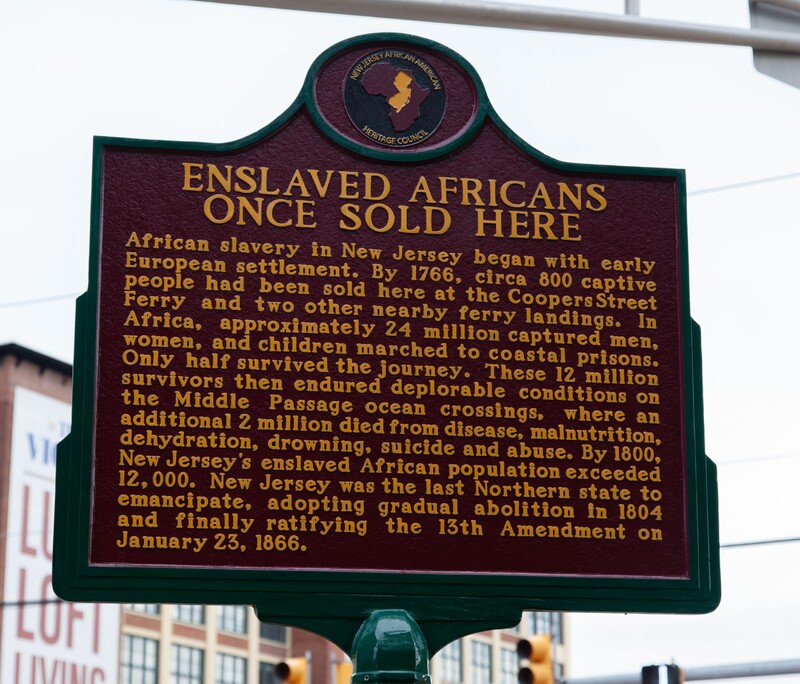
Historical marker at Cooper and Front Streets.
Daniel Cooper (1719-76)
Cuff, Jack, Will, Jem, Rose, Litchfield (or Linchfield), girl possibly named Sylvia
In the next generation, William’s son Daniel Cooper (1719-76) continued to enslave people despite growing opposition to the practice among the Quakers. At the Federal Street Ferry, he also kept enslaved African men, women, and children from Barbados until they could be sold.
While owning land and the Parson’s Hotel at Front and Federal Streets in Camden, he resided in Philadelphia, which placed him under the discipline of the Philadelphia Monthly Meeting. The Quakers repeatedly sent visitors to dissuade him from slave-trading, but he resisted.
Glimpses of the individuals enslaved by Daniel Cooper are preserved in advertisements that he placed in The Pennsylvania Gazette:
May 2, 1751:
To be sold by Daniel Cooper, in the Jerseys,
A likely Negroe fellow, about 26 years of age, well acquainted with country business, and has had the small pox and measles. Enquire of William Cooper, in Market-Street, Philadelphia.
October 10, 1751:
Run away from Daniel Cooper, at the ferry, opposite to Philadelphia, on the 18th of September last, A Negroe man, named Cuff; he belonged near two years ago to Anthony Morris, Junior, he is about 30 years of age, a middling lusty fellow, pitted about the nose with the small-pox: He took with him two jackets of a black and white twilled homespun, the back of the upper one is lined with tow cloth, a pair of good leather breeches, a pair of trousers, and a pair of shoes. Whoever secures said Negroe, so that his master may have him again, if within 5 miles from home, shall have Twenty Shillings reward, and if farther off, Thirty Shillings, and reasonable charges, paid by Daniel Cooper.
When Daniel Cooper composed a will in 1768, his bequests to family members still included at least five enslaved Africans: three men named Jack, Will, and Jem; a woman named Rose; and a boy named Litchfield (or Linchfield). A description of the enslaved man named Will appeared in The Pennsylvania Gazette on October 11, after he attempted to escape to freedom:
FOUR DOLLARS Reward:
Run away from the subscriber, living opposite to Philadelphia, in the Jerseys, on the 23rd of September last, a lusty likely NEGROE man, named WILL, of the blackest cast, about 30 years of age; had on, when he went away, a darkish coloured grey homespun jacket, without sleeves or lining, with pewter buttons, tow shirt and trousers, and a pair of new shoes; it is supposed he is lurking about Philadelphia. Whoever takes up said Negroe, and delivers him to the master of the work-house, or secures him in a goal [jail], so that his master may have him again, shall have the above reward, and reasonable charges, paid by DANIEL COOPER.
N.B. His dress is uncertain, as he has been seen since he went away, in a white shirt, a red lapelled jacket, black knit breeches, &c.
When Daniel Cooper died in 1776, the same year that the Quakers banned their members from enslaving other people, the inventory of his estate still included five enslaved individuals. They included the individuals named in the 1768 will except for Jem; in addition, the inventory included a girl possibly named Sylvia.
In 1779, Daniel Cooper’s son Joshua signed manumission papers to free the enslaved man Litchfield/Linchfield, who was then 23 years old.
William Cooper (1740-87)
Jacob, Rose
A receipt documents that William Cooper (1740-87), the oldest son of Daniel, sold a “Negro man named Jacob” in 1768 on board the Brig Dispatch, which was bound for Lisbon. The same Jacob apparently had attempted to escape to freedom, according to this advertisement in The Pennsylvania Gazette on July 10, 1766:
Run away from the Subscriber, living in Gloucester County [today’s Camden County], West New-Jersey, at the Ferry, opposite Philadelphia, on the 7th Instant, a Negroe Man, named Jacob, is about 22 years of age, 5 feet 8 inches high, has sharp filed Teeth, and is apt to stammer when he talks fast; had on, and took away with him, a Tow Shirt and Trousers, Cloth-coloured Jacket, lined with green, a striped Linen Shirt and Trousers, half worn shoes, with Brass Buckles, and an old Beaver Hat, with a Brass Button. --- Whoever takes up, and secures said Negroe, so that his Master may have him again, shall have the above Reward, and reasonable Charges paid, by William Cooper.
N.B. All Persons are desired not to harbour or conceal said Negroe, or they may expect to be prosecuted as the Law directs.
In 1770, a William Cooper also purchased an enslaved woman named Rose from Thomas Denny for fifty pounds. William Cooper apparently did not enslave anyone by 1787, when the bequests in his will did not include any enslaved persons.
Richard Matlack Cooper (1768-1843)
Richard Matlack Cooper inherited the future campus land from his father, William, but did not inherit or own enslaved people. His wife and distant cousin, Mary Cooper, came from a branch of the family that had become active in the abolition movement. This Cooper family lived in the block known today as Johnson Park.
As a Justice of the Peace for Gloucester County, in 1816 Richard Matlack Cooper signed a manumission document to free an enslaved woman named Selena. The manumission was filed by Dr. Samuel Harris, who lived on the southeast corner of Front and Cooper Streets, diagonally across from today's Johnson Park. In 1819, as an executor for the estate of a cousin, Joseph Cooper, Richard Matlack Cooper also signed a manumisson to free Cornelia McLaughlin Kennedy, "a female Mulatto Slave."
The Underground Railroad
William B. Cooper (1814-1888)
A member of the Cooper family who became active in the Underground Railroad later lived at 407 Cooper Street, which is now the home of the Rutgers—Camden Department of Sociology, Anthropology, and Criminal Justice. While the owners of the future campus area descended from the original Cooper settler’s youngest son, Daniel (1673-1715), William B. Cooper descended from an older son, Joseph (1666-1772). He was a nephew of Mary Cooper, who lived in the mansion that once stood on the site of today's Johnson Park.
William B. Cooper was born in 1814 and in the tradition of his Quaker family, he attended the Newton Friends School and later the Westtown Boarding School in Chester County, Pennsylvania. He returned to New Jersey and joined his father and brother Benjamin in farming the Cooper land.
According to an 1886 history of Camden County, the two brothers and their father were “in the days of slavery … devoted friend[s] of the refugee slaves, and would do anything to comfort and protect them.” Research by the Camden County Historical Society has identified the Camden area as “Station A” on the Underground Railroad in New Jersey. Waterways were important routes for freedom-seekers, and the Coopers’ Stockton Township property afforded an especially useful location on the Delaware River opposite Petty Island.
After the Civil War and his retirement from farming, Cooper moved to 407 Cooper Street in 1876 with his wife, Phoebe, and older sister, Elizabeth. For the work of the household, they employed Black domestic servants. All three of the Coopers at this address played roles in managing and supporting the West Jersey Orphanage for Colored Children, which had been founded in 1874. The orphanage provided education and health care, but it also sought to “bind out” children over the age of 12 to enable them to learn trades or other employment.
-- By Charlene Mires, posted September 1, 2026.
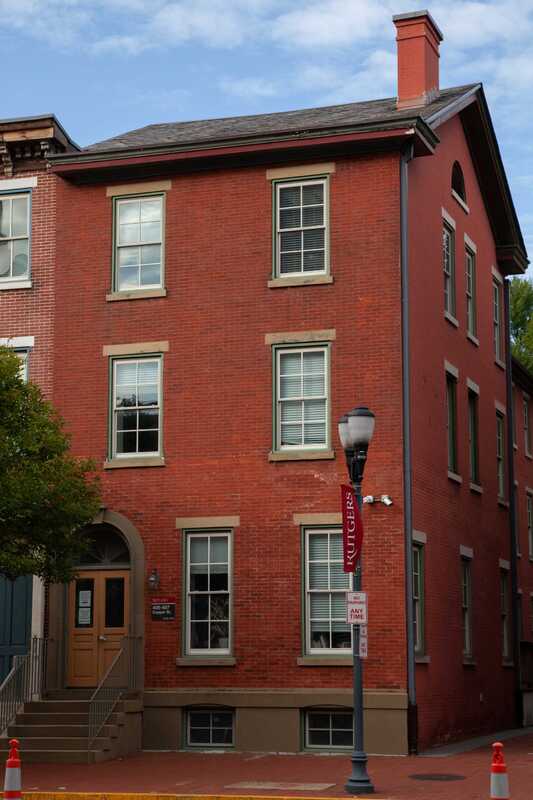
407 Cooper Street (2019 photograph by Jacob Lechner).
Sources / Further Reading
"African Americans in New Jersey Before the Civil War." In Struggle Without End: New Jersey and the Civil War. Rutgers University Libraries.
Camden County Historical Society. "Demolished Cooper Houses of Camden City." Camden County Heritage (Spring 2025), 7-8.
Camden County Historical Society. "Enslaved Africans Arrive at Camden's Ferries." Camden County Heritage (Spring 2018), 15-16.
Gigantino, James J. II. The Ragged Road to Abolition: Slavery and Freedom in New Jersey, 1775-1865. Philadelphia: University of Pennsylvania Press, 2015.
The Pennsylvania Gazette.
New Jersey Slavery Records, https://records.njslavery.org/s/doc/page/home.
Quaker Meeting Records (Ancestry.com).
Williams, Noelle Lorraine. "New Jersey, The Last Northern State to End Slavery." New Jersey Historical Commission.
Wills and estate inventories (Ancestry.com).
Acknowledgment: Bonny Beth Elwell of the Camden County Historical Society generously provided access to her collection of records of enslavement in Camden County and genealogy of the Cooper family.