
Flashback: Raymond Academy
Jay Gould was an infamous multimillionaire from New York. So, what led him to finance a private school in Camden?
To some, Gould was an accomplished captain of industry who amassed a railroad empire in the late nineteenth century. To others, he ranked as a “robber baron” who profited from stock manipulation and other unscrupulous business practices.
Surprisingly, Gould was also the benefactor of Raymond Academy, which operated at 419 Penn Street, on the current site of the Robeson Library. For twelve years between 1886 and 1898, well-to-do Camden families sent their young sons here to prepare for elite boarding schools in Philadelphia. For girls, Raymond Academy offered not just the lower grades but also advanced courses, including preparation for college.
How did this come to pass?
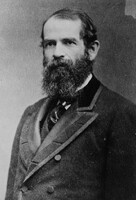
Jay Gould (Library of Congress)
A Widow’s Journey
The story of Raymond Academy begins with Jay Gould’s older sister, Sarah B. Northrop. In the late 1870s, as a widow raising eight children, she moved to Camden so that her oldest daughter, Ida, could take a job teaching kindergarten.
Kindergarten was then gaining in popularity in the United States. Ida, who had completed at least one year at Vassar College, would have been a well-qualified teacher. In Camden, she may have begun by teaching in an existing kindergarten, but by 1880, she began to advertise herself as an independent kindergarten teacher in her family’s rowhouse at 519 Linden Street (a block later replaced by the Benjamin Franklin Bridge approach).
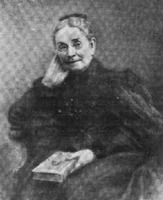
Sarah B. Northrop (Historical Journal of the More Family)
A Niece’s Ambition
Ida Northrop, who was about 24 years old in 1880, had ambitions beyond kindergarten, however. Over the next five years she expanded her enterprise into a private day school for older children as well, with about seventy pupils and four teachers. Her vision was no doubt encouraged by her mother, who had been a teacher prior to her marriage. She also attracted material support from her famous uncle, who viewed the school as a good investment to provide employment and financial security for his extended family.
In 1886, Jay Gould financed an impressive stone house and adjoining school building for the Northrop family in the 400 block of Penn Street. The structures stood across the street from the lawn of the finest house in the neighborhood, the Ayer family mansion at 406 Penn Street (now the Rutgers—Camden Admissions Office). The Northrops’ house resembled the Ayer family’s stone French Second Empire residence in style and materials, although it was not as large. Ida had free reign to design the school building, which had a first floor with partitions that could be opened to create an auditorium and a second floor with five classrooms.

"Private School" on this 1891 Sanborn Insurance Company map indicates the site of Raymond Academy, facing Penn Street. Much of the block is currently the site of Robeson Library. (Princeton University Libraries)

Advertisement, Camden Post, 1886.
Raymond Academy
Ida Northrop named her new school Raymond Academy, in honor of former Vassar College President John H. Raymond. While her school did not have a formal connection with Vassar, Northrop intended to prepare young women to advance to Vassar or other colleges. To aid in the mission, she hired Vassar graduate Eva March Tappan as a teacher and assistant principal. Other teachers were similarly qualified with college degrees, teacher preparation courses, or achievements in the arts.
Raymond Academy still offered kindergarten, along with elementary and intermediate grades for boys and girls. From that point, boys left to attend elite Philadelphia academies like Penn Charter and Friends’ Central. Girls could continue to advanced academic instruction, including preparation for college. Young women followed this path to Vassar, Swarthmore, Mt. Holyoke, and other prestigious institutions.
The school also instilled habits of philanthropy in its privileged students. Beginning in its first year of operation, the school hosted “street waifs” for a Thanksgiving dinner, and even the kindergarteners raised funds for orphans of the Camden Home for Friendless Children and the West Jersey Orphanage.
Transition
Raymond Academy showed every sign of success, enrolling between sixty and one hundred or more students each year. However, in the early 1890s, Ida Northrop’s health faltered. Without disclosing her condition, she announced that she would have to give up her role as teacher and principal. She assured her students and their parents that the school would continue.
The 1894 school year opened with a new principal with impressive credentials. Helen Tuxbury, a graduate of Smith College, also had a master’s degree from the Massachusetts Institute of Technology. She personally took on the teaching of science, and the school instituted a “scientific” track for the older girls.
The End
Raymond Academy operated long enough for its earliest kindergarteners to reach their college years. However, in 1898, Helen Tuxbury received a job offer to head the science and mathematics department at a private school in Philadelphia. This time, there was no successor. The Camden Daily Telegram noted solemnly, “A Popular Educational Institution Passes Into History.”
For a few months, a music school moved into the former Raymond Academy. But in 1899, the school building and the adjacent house at 421 Penn Street had a new owner. J.R. Eastlack, a prominent Camden grocer, bought the property because of the house, which the Daily Telegram described as “one of the most desirable in the northern residence part of Camden.” He soon demolished the school building.
All traces of Raymond Academy disappeared from Penn Street, although not the memory of Jay Gould, its famous benefactor. During the 1950s, 421 Penn Street was divided into rental units known as “Gould Manor Apartments.” In 1955, educational uses returned when Rutgers University acquired the lots once filled by the Northrop family home and school for the first phase of the Camden campus library.
-- By Charlene Mires, posted September 16, 2026.
Research by Audrey Johnson and Charlene Mires.
Sources
Camden and Philadelphia newspapers (Newspapers.com and GenealogyBank.com).
Camden City Directories (Ancestry.com).
The Historical Journal of the More Family (biography of Sarah Burr Northrop in No. 5, 1898, pp. 47-48; biography of Ida Northrop in Vol. 3, November 1935, p. 88).
Klein, Maury. The Life and Legend of Jay Gould. Baltimore: Johns Hopkins University Press, 1986.
More, Grace Van Dyke, ed. Chronicles of the More Family. Greenboro, N.C.: Piedmont Press, 1955.
Sanborn Insurance Maps, Princeton University Libraries.
Snow, Alice Northrop, with Henry Nicholas Snow. The Story of Helen Gould. New York: Fleming H. Revell Company, 1943.
U.S. and New Jersey Census Records (Ancestry.com).
Vassar Miscellany, Vol. XVI, No. 3 (December 1, 1886).
Cite: Charlene Mires, "Raymond Academy," Learning From Cooper Street, https://onlineexhibits.camden.rutgers.edu/s/cooper-street/page/raymondacademy.