
Flashback: Arthur E. Armitage
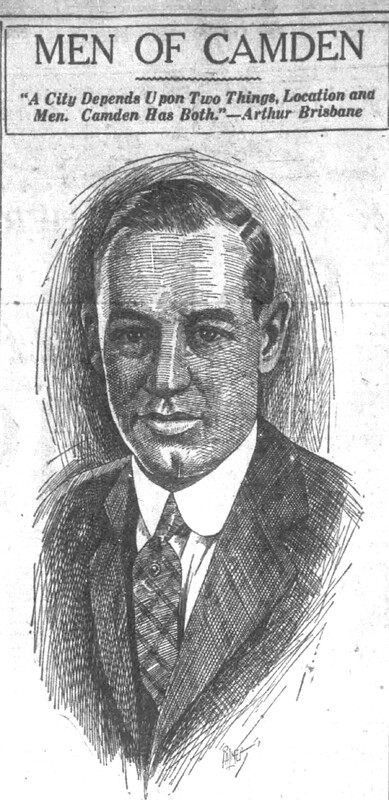
Arthur E. Armitage, Camden Evening Courier, 1926
Arthur E. Armitage, the namesake of Armitage Hall, devoted a lifetime of service to Camden and nearby Collingswood.
Born in East Orange, New Jersey, in 1891, Armitage grew up primarily in Newark as the middle of three siblings. When he was just six years old, his father died, and by age 11 he was working. After briefly running errands for his older brother, a butcher, he landed a job in the machine shops of the prolific inventor Thomas Alva Edison, known for his work on the incandescent light bulb, the phonograph, early motion pictures, and other breakthroughs. From the machine shop, young Armitage advanced to Edison’s laboratories, where he helped with experiments with storage batteries. Apparently showing promise, in 1910 he left New Jersey to attend the Gettysburg Preparatory School in Pennsylvania, a step toward enrolling in Gettysburg College. He took that next step in 1910-12. While in college, he played football, joined a fraternity, and served as secretary for a society of students from New Jersey.
Armitage remained a committed supporter of Gettysburg College throughout his life, but he left before completing a degree. Returning to North Jersey, he channeled his interests in sports, religion, and public service into a career with the Young Men’s Christian Association (the YMCA). The organization’s commitment to the physical and moral development of young men may have held appeal for Armitage, who had been left fatherless at such a young age. The Young Men’s Christian Association had been founded in England in 1844 as a young men’s alternative to life on the streets, and it took root in the United States by 1851. Armitage’s hometown of Newark had a YMCA during his youth, as did Gettysburg College. By the time Armitage began working for the YMCA in Orange, New Jersey, in 1913, it was common for YMCAs to offer gymnasiums, housing, and education programs.
Arrival in Camden
A position with the YMCA brought Armitage to Camden, where the association’s presence and membership had been growing exponentially. Led by devoted local boosters including Francis Wayland (F.W.) Ayer, a nationally prominent advertising executive, the Y had opened a substantial new building on Federal Street near Broadway in 1910. Armitage joined the Camden Y in 1916 as education secretary, which placed him in charge of a night school offering a vast array of academic and commercial subjects for young men at low cost. Consequentially for Armitage’s future role in creating a campus for Rutgers—Camden, the position placed him in direct contact with F.W. Ayer, who served on the Y’s education committee and lived in a mansion at 406 Penn Street (now the Rutgers—Camden Admissions Office). As education secretary, Armitage expanded the Y’s offerings for underprivileged youth and started classes to teach industrial skills and to guide immigrants toward citizenship. In 1918, he was promoted to general secretary.
By the time he arrived in Camden, Armitage had married fellow Newark native Gertrude Krais (known as Sally), a former schoolteacher. They moved into a rowhouse in the Parkside section of Camden, where they started a family—a daughter, Virginia, born in 1917, and a son, Arthur Jr., born in 1920. They joined the Holy Trinity Lutheran Church in their neighborhood, and Armitage joined the Rotary Club, a men’s service club that met at the YMCA. As a Rotary Club member, he raised money to grant loans to students who would not otherwise be able to afford to go to college. With the Rotary Club and elsewhere, he quickly became a fixture for multiple campaigns for civic causes, from boys’ welfare to a museum for the Camden County Historical Society. By 1922, when the Camden Post-Telegram featured him in its “Who’s Who in Camden Rotary” series, his community roles included serving as superintendent of the Sunday School and Church Council member of Holy Trinity Lutheran Church and president of the Spartan Building and Loan Association. Among many other activities, he officiated high school and college football games.

Arthur E. Armitage, undated photograph (Rutgers University Archives)
College Co-Founder
While deeply rooted in providing educational opportunities through the YMCA and the Rotary Club, Armitage extended his sights to higher education. He proposed and became co-founder of the South Jersey Law School (1926), which enabled local residents to become lawyers after two years of classes instead of three years studying in an attorney’s office. The next year, he co-founded the College of South Jersey, which gave local people access to the two years of undergraduate study that law schools required for admission. These two institutions were the forerunners of Rutgers—Camden, throughout a merger with Rutgers completed in 1950.
While still working at the YMCA, Armitage took on the role of registrar (later secretary-treasurer) for the new institutions while attorney Elmer G. Van Dame became president. He ascended to the presidency of the two schools in 1940. In that role, in 1946 he secured the first property of the current Rutgers—Camden campus when he purchased the former home of his YMCA colleague, F.W. Ayer, at 406 Penn Street. The building, now serving as the Admissions Office, anchored the development of the current Rutgers—Camden campus.
Collingswood Government
Meanwhile, the Armitage family had moved from Camden to neighboring Collingswood. Until 1933, Armitage maintained his position with the YMCA simultaneously with the Law School and the College of New Jersey, but he then pivoted to new pursuits in business and government. His resignation from the YMCA in 1933 completed twenty years of employment with the association, seventeen of them spent in Camden. At this juncture, Armitage opened an insurance agency while continuing his role with the Law School and College. On the political front, he won election to the Collingswood Borough Commission. A Republican, he advanced to the position of mayor in 1936, beginning a tenure that lasted until 1969—the longest continuous service for any mayor in the United States up to that time.
During his long life, until his death at age 90 in 1981, Armitage received numerous awards for his work in civic affairs, higher education, politics, and athletics. He served on the New Jersey Board of Education, as an officer in associations of football officials, and on the boards of organizations such as the Camden County Boy Scout and Girl Scout Councils, the Camden Home for Children, Goodwill Industries of South Jersey, and the United Fund. In 1968, Rutgers gave his name to the newest addition to the growing modern campus of Rutgers—Camden, Armitage Hall. Today, he is also recalled each year by the Arthur Armitage Distinguished Alumni Award, which is bestowed by the Rutgers University School of Law-Camden Alumni Association. Near Collingswood, he is commemorated by the Armitage Pavilion picnic area in Cooper River Park.
-- By Charlene Mires, posted August 3, 2026.
Sources:
Camden and Philadelphia newspapers.
Gettysburg College yearbooks and alumni publications.
New Jersey State Census, 1895-1905.
U.S. Census, 1900-1950.
Cite:
Charlene Mires, "Arthur E. Armitage," Learning From Cooper Street, https://onlineexhibits.camden.rutgers.edu/s/cooper-street/page/armitage.