Significance
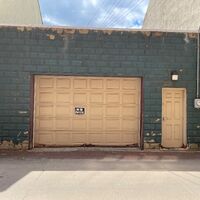
The concrete block garage, built c. 1939-50, was an example of the ways that Camden adapted to the advent of automobiles in the city. Originally serving the funeral home operating at that time at 423 Cooper Street, the garage replaced two nineteenth-century, working-class rental rowhouses. The house at 428 Lawrence Street was the early childhood home and possibly the birthplace of Edward A. Reid, who later in life was the first Black judge to be appointed for the Camden County courts.
History
A cement-block garage, built for a Cooper Street undertaker c. 1939-50, most recently stood on the site of two earlier rowhouses similar to others that survive on Lawrence Street. The earlier houses dated to the period c. 1847-54, when they were built on land purchased by Jesse Townsend, a bank clerk. In 1847, Townsend acquired property extending from Cooper Street to Lawrence Street, and like several of his neighbors he added houses facing both streets. At 423 Cooper Street, Townsend and his wife, Elizabeth, raised a family that grew to include five children as Jesse Townsend rose to the position of cashier at one of Camden’s key institutions, the State Bank of Camden. The smaller rowhouses at 428 and 430 Lawrence Street were rented to tenants. During the 1860s, the Townsends sold their house and the pair of rental properties separately to new owners. They moved to 215 Cooper Street, closer to the bank, in 1862; five years later, they sold the pair of Lawrence Street houses to investors from Cumberland County.
428 Lawrence Street
The absence of house numbering prior to 1861 prevents identifying tenants by address in earlier years, but city directories document people living in the 400 block of Lawrence Street beginning in 1854. The earliest who can be identified with certainty at 428 Lawrence Street were members of the extended family of a blacksmith, John A. Brown, who lived at this address between 1861 and 1867. When documented in 1860 at their previous address, they were a household of nine people. Brown, a white man 47 years old, born in New Jersey, headed the household with his wife, Debra, a white woman 44 years old, and they had five offspring ranging in age from 9 to 22. Their oldest daughter worked as a dressmaker, and their oldest son as a journeyman hatter. Also in the household were plasterer Van T. Shivers and a 2-year-old child, Lorenzo Shivers, who may have been a son-in-law and grandchild of the Browns. By 1863 the Browns left the Lawrence Street address, but Shivers stayed until 1867.
In 1867, the owner of the adjacent 428 and 430 Lawrence Street rowhouses, Jesse Townsend, put them up for sale. Townsend had already sold the associated Cooper Street-facing house (423 Cooper) and moved to another Cooper Street house closer to the State Bank of Camden, where he worked. When Townsend advertised the Lawrence Street houses for sale in the West Jersey Press, he described their potential as investment properties: "Two Small Houses / For Sale Cheap / The subscriber offers for sale two small Brick Houses, No. 428 and 430 Lawrence Street, Camden, N.J. These houses contain five rooms each, are well built, have range in kitchen and hydrant water in yard, and will be sold so as to net from 10 to 12 per cent per annum clear of taxes. A portion of the purchase money may remain on mortgage.” The two houses quickly sold to a couple living in Cumberland County and remained rental properties.
Skilled Tradespeople
Tenants moved in and out of the 428 Lawrence Street rowhouse frequently for the rest of the nineteenth century. Their occupations reflected the range of skilled trades then in demand in Camden, including building trades (mason, carpenter, bricklayer); crafts (tinsmith, caner, weaver); and clothing-related occupations for women (tailoress, dressmaker). Tenants at 428 Lawrence Street also included a railroad brakeman and people working in office jobs (clerk, stenographer). Most tenants during this period, to the extent that they can be identified, were white and born in New Jersey or Pennsylvania, although some had parents who were immigrants. In large families, adult children worked outside the home, but younger sons and daughters attended school.
By 1900, 428 Lawrence Street and several others nearby became homes to Black families with members who migrated from the South in the decades following the Civil War. James T. Reid, a Black man born in North Carolina, migrated to Philadelphia by 1890 and then, after marrying and starting a family, moved to Camden by 1899. The Reid family rented 428 Lawrence Street between 1899 and 1903. Reid worked as a butler and waiter while at this address and later as a gardener and odd-jobs laborer. In 1900 on Lawrence Street, the Reids were a household of six people: James Reid, 34 years old; his wife, Mary, a Black woman 34 years old, who was born in New Jersey; and four daughters ranging from 1 to 8 years old. While at this address, the Reids added two sons to their family.
Judge Edward A. Reid
One of the sons born to the Reid family while they lived at this address became prominent in later years as the first Black judge appointed for the Camden County courts. Edward A. Reid, born on May 29, 1902, later graduated from Camden High School, Howard University, and the Howard University law school. He returned to Camden to practice and served as a borough solicitor and municipal judge for the predominantly Black community of Lawnside, as an assistant Camden County prosecutor, and ultimately as Camden County Juvenile and Domestic Relations judge. For a time he had his law office at Sixth and Cooper Streets, not far from his first home in Camden; by the time he died in 1967 he lived in the nearby Northgate Apartments, then a recently built luxury high-rise. Active in community affairs including the NAACP and United Fund of Camden County, in 1965 Reid received a community service award from the AFL-CIO.
Racial and ethnic diversity continued to be present at 428 Lawrence Street in the early decades of the twentieth century. In 1905-06, the tenants were Joseph Mallay, a chef who had been born in Japan in 1860, and his wife, Elizabeth, a Black woman whose parents had been born in Virginia. Several tenants later, in 1910, three occupants of 428 Lawrence Street had ancestral connections with western Europe: Andrew Wiliams, 38 years old and working as a cook in a canning factory, was a son of a German immigrant; his wife, Margaret, also 38 years old, immigrated from Ireland. They shared the home with a widowed woman of the same age, Clara A. Stewart, a daughter of German immigrants who worked as a trimmer in a lace factory. By 1915, a couple both born in England occupied the home: Thomas H. Hewley, 33 years old, a steamfitter, his wife, Florence, age 37, and their 4-year-old son Thomas. By 1920, a young couple who were both Irish immigrants lived at 428 Lawrence Street with their infant daughter.
Tenants of the early twentieth century sought employment by placing ads in local newspapers. Women sought to do washing at home, and at times they offered rooms for rent even though the house totaled only four or five rooms. A baker advertised his skills at making bread; another sought work “of any kind.” In 1912, an advertisement described an occupant of 428 Lawrence Street as well as his skills: “Middle-aged, fairly educated, temperate man, wants position of any responsible nature; thoroughly understands reading of blueprints and handling of men.”
After years of frequent turnover of tenants, 428 Lawrence Street gained relatively long-term renters during the 1920s when it became home to the family of a shipyard worker, Frank J. Read, and his wife, Eva. They had been married about ten years when they moved from another rental a few blocks away on Mickle Street. Both of the Reads were children of immigrants, in his case from Ireland and in her case from Austria. When they moved to Lawrence Street, Frank Read was 31 years old and Eva was 27; while at this address, their family grew from three children to six, and the household may have included one other adult lodger or relative, an Irish immigrant widow, Sara Colley.
Automobile Garage
By the 1920s, the Cooper Street-facing house behind 428 and 430 Lawrence Street had become a funeral home and residence for the operator, Charles Hiskey. The Lawrence Street houses remained a rental property for a succession of tenants during the 1930s, but in 1939 Hiskey bought them and then built a concrete-block automobile garage in their place. The garage changed hands in concert with 423 Cooper Street through a series of owners in the later twentieth century, including a doctor who had his office in the Cooper Street building during the 1960s and 1970s. Rutgers University first gained title to the properties in 1984 and in the early 1990s, after demolishing 423 Cooper Street, entered into a partnership with a redevelopment firm. The project included renovations of 321 and 411 Cooper Street and the potential for new construction in place of 423 Cooper. However, by 1998 that project faltered. With the garage still standing on the site of the Lawrence Street rowhouses, Rutgers regained title to the property again in 2005. The garage was later demolished during 2025-26 during construction of the Cooper Street Gateway Building.

 423 Cooper StreetSee all items with this value
 428 Lawrence Street (Demolished)See all items with this value
 430 Lawrence Street (Demolished)See all items with this value