Significance
422 Lawrence Street forms part of a row of nineteenth-century, working-class houses that originated as rental properties erected by owners of grander homes facing Cooper Street. The row was included in the Cooper Street Historic District’s nomination to the National Register of Historic Places in 1989 to provide a “comprehensive view of Cooper Street’s social history" and “a clear view of the economic and social dichotomy that has continued to typify Camden." 422 Lawrence Street is notable for its connections with many of the waves of migration and immigration that formed Camden's diverse population.
History
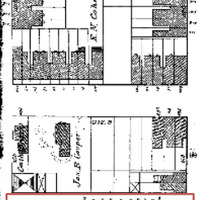
At the back of three Cooper Street-facing properties (413 through 417), four two-story houses were added facing Lawrence Street during the late 1840s and early 1850s. The collective development of seven residences stood on land purchased in 1845 and 1846 by Hannah Atwood, who lived at various times in one of the Cooper Street homes or in Philadelphia. When rented to others, the houses on Cooper and Lawrence Streets provided a steady income while Hannah’s husband, Jesse Atwood, pursued a career as a traveling portrait artist. He was best known for an 1847 portrait of General Zachary Taylor, the Mexican-American War hero who later became president of the United States.
422 Lawrence Street
The two-story, four-room brick house at 422 Lawrence Street likely dates to the early 1850s, when other similar houses are known to have been built in the same row. The absence of house numbering limits the identification of tenants by address prior to 1861, but city directories documented people living in this block of Lawrence Street beginning in 1854. The earliest tenant of 422 Lawrence Street who can be identified from public records was Charles Storm, a hat finisher, who rented the house in 1860-61. Storm, 42 years old in 1860, was a white man born in New York who headed a household of six people at this address: his wife, Ann, a white woman also 42 years old, who was born in Philadelphia, and four children ranging in age from 2 to 22. The oldest daughter, Catharine, worked as a dressmaker.
By 1862, a veteran of the Civil War headed the family who rented 422 Lawrence Street. Montraville Williams served as a drum major with the Third New Jersey Volunteer Infantry. Born in Massachusetts in 1832, Williams was educated at the private, nonsectarian Leicester Academy and worked as a bootmaker before relocating to Camden in the mid-1850s. While working as a cordwainer (shoemaker), in 1855 he married Pennsylvania-born Fanny Riley in Camden’s Third Street Methodist Episcopal Church. By the time of the 1860 Census, they lived in Camden and their family had grown to include three daughters, the oldest 11 years old (apparently born to one of the parents prior to their marriage) and two younger girls ages 1 and 3.
By the time he went off to war, Montraville Williams identified his occupation as musician, and his military role as a principal musician meant that he trained drummers who beat cadences for troops in the field. During his enlistment from May 1861 until October 1862, his unit participated in the defense of Washington, D.C., and advanced into Virginia and Maryland with the Army of the Potomac. Williams mustered out of service following the Battle of Antietam with an unspecified disability. At home, meanwhile, Fanny fought battles of her own. She dealt with the death of their 2-year-old daughter Ella, who contracted smallpox and died in November 1861. Sometime within the next year, she and her surviving girls moved into the 422 Lawrence Street house, and she gave birth to another daughter there in October 1862, around the same time her husband returned from the war.
Disruptions and losses continued for the Williams family during the next six to seven years at the Lawrence Street address. In 1863 another of their daughters, six-year-old Ida, died of scarlet fever while on a visit to her father’s hometown in Massachusetts. By 1869, Montraville apparently left the family and Camden. Fanny appeared alone at 422 Lawrence Street in the Camden city directory in 1869, an indication of the absence of a male head of household. Thereafter, she moved to other addresses in Camden as she sought to support herself and her daughters as a tailoress and music teacher. She struggled in later life, including the public embarrassment of an eviction for nonpayment of rent that was reported in two Camden newspapers in 1888. Montraville, meanwhile, moved west. He may have lived in Chicago for a time, and he was later rumored to be in California. He died in Pueblo, Colorado, in 1905. That year, his long-estranged wife filed for a widow’s pension based upon her husband’s service during the Civil War.
Immigration and Industry
Industrialization and immigration to Camden are evident in the next series of tenants at 422 Lawrence Street. By 1870 a miller named Joseph Webster headed a household of six people, including two grown daughters who worked in a shoe factory. By 1880, an immigrant from Germany, Charles Kemmick, worked as a gardener and headed a family of four including his wife Caroline, whose parents were German immigrants, a 4-year-old son, and infant daughter. Occupations represented among the often-changing tenants of 422 Lawrence Street during this period included laborers, shoe cutters, drivers, bookkeepers, and a clerk.
Toward the end of the nineteenth century, 422 Lawrence Street had Black tenants for the first time – among the few Black residents at this or any other house in the Lawrence Street row. Records may not account for the full extent of these African American households, but they document the presence in 1896 of Martha Woolford, a Black widow who had recently been employed as a domestic at nearby 407 Cooper Street. After a short tenancy by a white family, the next two renters between 1899 and 1903 were Black food service workers. John and Addie Davis, a married couple in their late twenties, had both been born in Virginia and migrated by 1894 to Philadelphia. By 1899 they were in Camden and renting the house at 422 Lawrence Street. John Davis worked as a baker. The next tenant, a caterer, had been a lodger with another Black family in Camden prior to moving to Lawrence Street with one young son. At their previous address in 1900, Lena Duvall had been recorded as 40 years old, born in Delaware, and her son Leo was then three years old. The Census takers did not find Lena’s husband of eight years at home, although he apparently lived at least intermittently with his family in both locations. In 1901, he was accused of bigamy in Philadelphia after marrying another woman, and Lena crossed the river to present documentation of her marriage in court. She remained on Lawrence Street until 1903.
The fluidity of Camden’s population as industry expanded on the city’s waterfront is reflected by the tenants at 422 Lawrence Street by 1910, when a packer working at the Victor Talking Machine Company headed the family at this address. Charles L. Rhodes, a white man 54 years old, had been born in New York. His wife of seventeen years, 51-year-old Marietta, had been born in Georgia. They had one son, Arthur, who was sixteen years old in 1910 and attending school. The expansion of shipbuilding on the Delaware River also brought tenants to 422 Lawrence Street: throughout the 1920s, it became home to a family headed by a riveter, Albert Adams, a white man who was born in Ohio to parents who had immigrated from France and Germany. Forty years old in 1920, his household included his wife, Mabel, who was five years younger, also born in Ohio but to parents who had both been born in Virginia. Mabel’s mother and brother lived with the couple; her brother also worked in a shipyard on the Delaware. While Mabel’s brother moved on at some time during the 1920s, the rest of the family stayed on Lawrence Street through at least 1930.
Puerto Rican Presence
The house at 422 Lawrence Street remained a rental property through the Great Depression, although the identities of tenants are scarce because Camden did not publish city directories between 1931 and 1940. In 1940, the tenants included Charles Smith, a white man who worked as a church janitor, and his wife, a presser in a factory. Thereafter, however, the occupants of the house reflected the rising presence of Puerto Ricans in Camden. From 1943 until at least 1950, Puerto-Rican born Santos and Lucy Martinez headed a family of six at this address; at some point, they also purchased the home. The 1950 Census recorded Santos as 47 years old, white, and working as an electrician in a shipyard; Lucy, ten years younger than her husband, also white, operated a sewing machine in a dress factory. Their children, all of whom had been born in Puerto Rico, included four at home ranging in age from 15 to 21, in addition to an oldest son attending William Penn College in Iowa. Margarita, the oldest of their offspring at home, worked as a mender in a hosiery mill, and a nineteen-year-old son was a pin boy in a bowling alley. Another son, Nestor, turned eighteen in 1950, enlisted in the Army, and departed that year for basic training at Parris Island, South Carolina.
The history of 422 Lawrence Street next appears in the public record in the 1970s, when periodic missed tax payments put the property at risk of sheriff’s sale. In 1978, Santos and Lucy Martinez, who by then lived in suburban Woodlynne, sold the house Eric and Ellen Eifert, who then lived at 418 Lawrence Street. The Eiferts, who later purchased 418 and 420 Lawrence Street as well, sold all three properties to Rutgers University in 2007. In 2025-27, the facade of 422 Lawrence Street was preserved and incorporated into the Cooper Street Gateway Building.

 422 Lawrence Street (Facade)See all items with this value
 Atwood, HannahSee all items with this value